
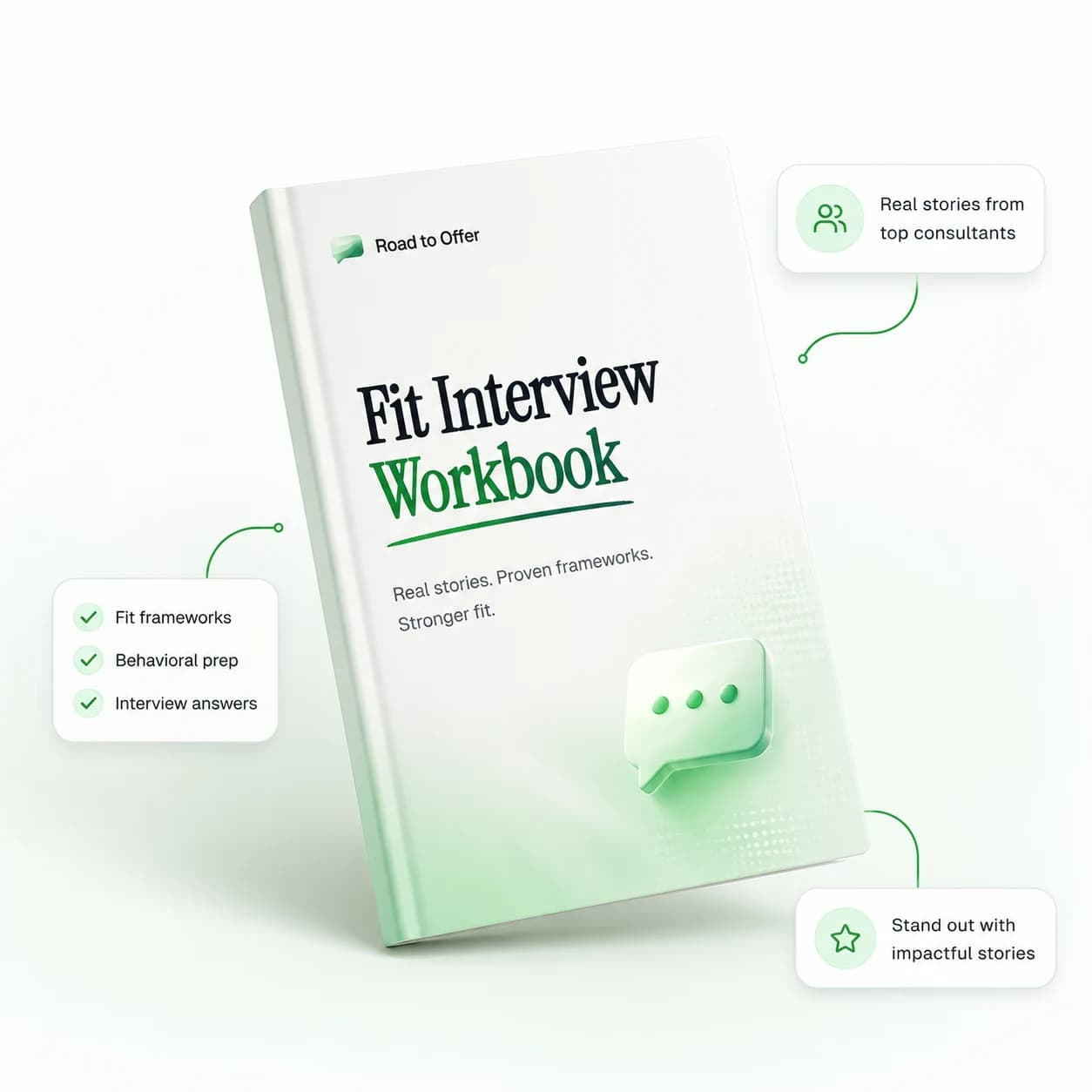
What is the PEI questions workbook?
The PEI questions workbook is a free PDF that turns the personal experience interview into a structured prep loop. It bundles a 40+ question practice bank, a probe list that mirrors how McKinsey interviewers drill into a single story for 10-15 minutes, and a story-bank worksheet that maps your real experiences to MBB fit signals. It is built for candidates who already know what the PEI is and now need to actually rehearse - not for someone reading their first overview article on behavioral interviews.
How does the PEI workbook compare to a general behavioral guide?
A guide explains the format. A workbook makes you practice it. The behavioral interview consulting guide walks through the STAR method, the difference between fit and case rounds, and the strategic frame of the interview. That guide is the right place to start if you have never seen a consulting fit question. The workbook is the next step: a sequenced set of prompts, probes, and worksheets you fill in until your stories hold up under pressure.
When should you read the guide first?
If you cannot yet name the four MBB signals (leadership, personal impact, drive, growth) and explain why interviewers ask about each one, start with the behavioral interview consulting guide and the case interview fit questions article. The workbook assumes that context.
When should you skip straight to the workbook?
If you can already explain the format, you have 4-6 stories drafted, and what you actually need is volume practice plus a way to find the holes - start here. Most candidates underestimate how much rehearsal closes the gap between a story that reads well on paper and one that survives 12 minutes of probing.
What does the workbook do that a guide cannot?
It forces a feedback loop. Across the candidate workflows we see most often on Road to Offer, the difference between a passing PEI and a failing one is rarely the story itself - it is the candidate's ability to stay specific and structured under follow-up pressure. A workbook with probe prompts simulates that pressure on your couch.
When should you use the PEI workbook?
The workbook earns its keep in the four weeks before your first MBB round. Earlier than that, it can pull focus from case prep, which still drives the larger share of round-one outcomes. Later than that, you will not have time to rewrite stories that are not landing. The sweet spot is roughly two to four weeks out, with two 45-minute sessions per week.
Are you preparing for a McKinsey first round?
The McKinsey PEI is the highest-stakes use case for this workbook. McKinsey interviewers spend roughly a third of every round - 10 to 15 minutes - on a single story, drilling into your motivation, your specific actions, and what you learned. The probe list in the workbook is built directly off this pattern. Pair it with the McKinsey case interview guide so the case half of the interview gets the same attention.
Are you prepping for BCG or Bain fit?
BCG and Bain cover more questions with less depth per question, so the probe list matters less and the story-bank breadth matters more. Use the workbook to map at least six stories that flex across signals. The BCG case interview guide and Bain case interview guide cover the firm-specific weight on creativity (BCG) and team orientation (Bain) that should bias which stories you lead with.
Are you a non-MBA or experienced hire?
Experienced hires often over-rely on work stories and end up with a fit answer that sounds like a project status update. The workbook has a worksheet specifically for surfacing leadership and growth signals from non-work contexts - community, athletics, side projects, side hustles - which usually round out the signal coverage and prevent the same client story from carrying three rounds.
How does the workbook actually work?
You move through three layers in sequence: prompts, probes, and self-review. Each layer takes a different amount of time and surfaces a different kind of weakness, which is why we built it as a loop instead of a single drill.
Step 1 - Pick a prompt and time yourself
Choose a question from the bank, hit a five-minute timer, and answer out loud. The first pass is meant to expose how the story sounds when it has to leave your mouth - not how it reads. Most candidates discover their opener is too long the moment they say it aloud.
Step 2 - Run the probe list
After the first pass, run the seven follow-up probes ("What was your specific role?", "Why did you choose that approach?", "What would you do differently?"). This is where McKinsey-style depth gets simulated. If a probe stalls you, the story has a gap.
Step 3 - Self-review against the rubric
Score your answer on the four signals, mark the moments where you went vague, and rewrite the story-bank entry. The case interview fit questions guide has a longer breakdown of the rubric logic if you want to read the philosophy before applying it.
Step 4 - Repeat with a different story
Do not run all seven probes on the same story twice in a row. The brain memorizes its own answer and the next session feels easy without actually being better. Rotate stories so each gets independent reps.
What real stories belong in your story bank?
Most candidates need 4-6 distinct stories to cover MBB signals without repeating themselves. The workbook has slots for each, with prompts that surface the right kind of detail.
Leadership stories
At least one team you led, one decision you owned, and one moment where you handled disagreement. Strong stories show specific actions, not just titles or outcomes.
Personal impact stories
A moment where you changed someone's mind, navigated conflict, or moved a project that was stuck. The McKinsey personal impact signal lives or dies on the specifics of the human dynamic, not the business result.
Drive and growth stories
One story where you went after something hard with no obvious payoff, plus one where you got direct negative feedback and changed because of it. The growth signal is the one most candidates underweight.